Friday, March 31, 2006

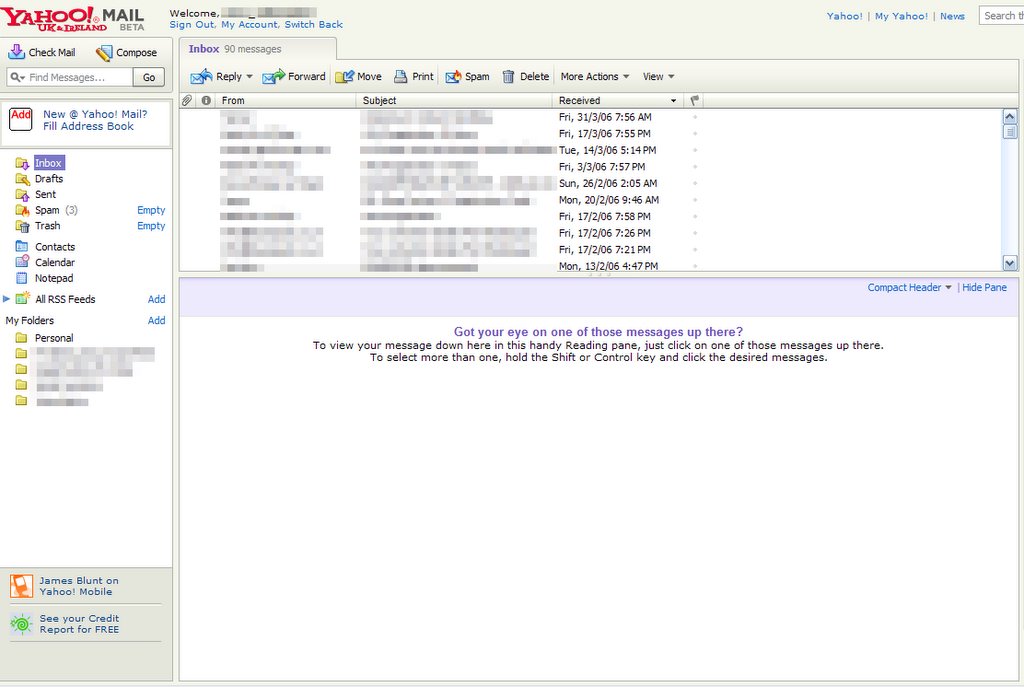
New Yahoo Mail Beta

Yahoo have released a beta of their Yahoo Mail webmail interface to Yahoo Mail users, it asked me whether I wanted to try the beta when I signed in recently. It uses Ajax, meaning that the interface is very slick and doesn't need to reload the page to do most things. It looks like a response to Google's Gmail, which has led in the area of webmail interface usability for some time. It may also be a response to the Windows Live Mail Beta, Microsoft's up-and-coming version of Hotmail, which also uses an Ajax interface.

In my opinion, at the moment I prefer the Yahoo Mail Beta to Windows Live Mail Beta, it has a nicer-looking interface and it works in both Mozilla Firefox and Internet Explorer, where Windows Live Mail at the moment only works in IE.

The question is, will Gmail be rivalled by this new version of Yahoo Mail? Or even Windows Live Mail?

What will Google do this year?

Tomorrow is April Fool's Day and now the question is what Google will do this year.

Famously, Google have always done something for April Fool's Day. They famously created a page detailing their search technology, and also recently released Gmail on April Fool's Day, prompting people to wonder whether it was a prank or not. Apparently it wasn't.

Will they release a new product tomorrow? Will it be GDrive, Google Calendar or something else??

Wednesday, March 29, 2006

Unofficial patches for IE flaw released

To follow up from this post about new security flaws being found in Microsoft's Internet Explorer browser, it seems third parties have leapt to the rescue and released patches.

Security companies Determina and eEye Digital Security

EU not happy about Vista's bundled features

Now just before I start, can I say that this story is likely to be highly speculative, and as yet there has been no confirmation by Microsoft of this report. If there are any updates about whether this is true or false (especially considering the 60% of Vista controversy), I'll follow up this post.

EU told Microsoft it had Vista competition concerns [at Unofficial Windows Vista Weblog] [at Yahoo News]

There have been some rumours that the EU Commission are threatening to block European sales of Microsoft's upcoming Windows Vista operating system if it includes certain features as standard, bundled with Windows.

EU spokesman Jonathan Todd was quoted as saying:

"We are concerned about the possibility that the next Vista operating system will include various elements which are currently available separately from Microsoft or other companies,"

I wouldn't go as far as the Windows Vista Weblog have gone in saying that they might block Vista in the EU, I think, if this story is correct, that it's more likely that Microsoft may have to remove some of Vista's new features from European markets (like the 'N' EU-only editions of Windows XP, bundled without Windows Media Player).

So, don't take this as fact (as I've probably reiterated too many times already), but it certainly may force Microsoft to change their strategy, at least in Europe.

Anyway, here's my personal take on this story, but make of it what you will.

Tuesday, March 28, 2006

Reblog

I have been wondering for some time why Bloglines seems to be the feed aggregator of choice for many people. It is buggy, often showing old items as new, it has a primitive interface and is short on features. Despite this, it is the market leader. I think the reason for this situation is a lack of decent competition. There's Google Reader, which offers even fewer features, a silly UI and lots of bugs, as well as countless other competitors, but none stand out.

That is, apart from Reblog. I discovered it recently on Lifehacker, and whilst I failed to install the Open Source code on my server, I have managed to use its hosted service. Reblog is buggy, but it is early stage OS software, so that is to be expected. It works by splitting up your newsreading in two; skim reading, and then reading in depth. You look through all your incoming news, quickly selecting options using the keyboard to archive, follow links, or most importantly, publish. The publish option publishes the item to a users 'reblog', where it can be read in greater detail later. I can now spend much less time reading news because I don't read everything I'm not interested in. I also pick up more stories as I feel able to subscribe to more feeds as I am now more efficient. My reblog can be found here.

The 'reblog' idea has greater potential, beyond just the user's benefit. If it were possible to subscribe to feeds within Digg, with the publish option either submitting the story or a digg of the story if it had already been submitted, then an extremely powerful Web 2.0 'reblog' community could be formed.

The other direction RSS is going is on the desktop. Obviously there's Microsoft's strides forward in the area, and there seems to be a new feed aggregator released daily, all with slightly different takes. Ultimately some sort of fusion of the 'Web 2.0 approach' and the Microsoft approach (a unified system based on an 'RSS platform') will provide the best future for feeds.

Why Windows is so slow

Windows Is So Slow, but Why?

This article by the New York Times is quite interesting, and it looks at why Windows can be so slow. Before people jump the gun, it's not an anti-Microsoft, anti-proprietary article, read it if you want.

It says that one of the main reasons that Windows is so bloated (with Vista set to have about 4 times as many lines of code as XP) is that it keeps backward compatibility with old software and hardware.

The interesting comparison that they made here was with Apple and Mac OS. In 2001, Apple bit the bullet with Mac OS X. They basically rebuilt the whole operating system from scratch (OK, not quite, but you get the idea) and built it on a foundation of Unix. It was a major change in the way Mac OS worked, and none of the Mac OS Classic applications ran on it (you had to run a 'Classic' virtual machine).

XP was also a big step forward in the evolution of Windows, being the first consumer Windows OS to ditch the ageing 95/98/Me setup and go for a Windows NT-style setup. But the support for 95/98/Me applications is still there today, and although that is a good thing, it does make Windows more bloated, and hence slower.

I think that the question is, will Windows change like OS X did? With the release of Windows XP Professional x64 Edition (the version of XP for 64-bit processors) and with Windows Vista being released for both x86 (current generation Intel and AMD CPUs) and x64, we may well see older applications losing support and perhaps evolution on the Windows platform. Through that, Microsoft might not see the need to keep lines and lines of code to run legacy Windows applications, and hopefully, Windows speeds up a bit.

But will Microsoft ever do an OS X and completely overhaul everything? Will it be Vienna (the codename for the successor to Vista) that brings about this change? My answer, I don't know.

Monday, March 27, 2006

More bugs in IE found

Microsoft have announced that they have discovered more security flaws in their Internet Explorer browser for Windows. One of these vulnerabilites simply causes the browser to crash, but some of the others could be used to gain complete control of a victim's computer.

These bugs affect versions 5.x and 6.x of Internet Explorer, but not the recent 7.0 Beta. So, needless to say, patch up as soon as they release the update (which should be 11th April), regardless of which browser you use. The reason behind this is that applications use the Internet Explorer framework (such as Outlook Express), even if you use an alternative browser for day-to-day browsing (like Firefox).

There's an interesting story about this exploit here.

PS3 online service being prepared


Sony are planning to build an online service, similar to Microsoft's Xbox Live, on their upcoming PlayStation 3 console.

It will allow gamers to download games direct to the PS3's hard drive. Like the new Xbox Live service with the Xbox 360, the basic service will be free to all PS3-owners, but to play games online a subscription will be required.

The PS3 will still be subject to the delay, and won't ship until November this year, because of the issues with Blu-ray disc copy protection.

This certainly will be a formidable rival to the Xbox 360, however, with Sony already owning the majority of the video games console market.

Friday, March 24, 2006

Vista not being rewritten

Robert Scoble (who works for Microsoft) rather forcefully refutes the allegation that 60% of the code for Windows Vista was being hurriedly rewritten in these two posts:

Whenever you see a story that says 60% of any OS is gonna be rewritten you should demand that the journalist who wrote that be immediately and publicly fired. Totally 100% incompetent. Did NOT do their homework.

There is NO WAY a major OS can be rewritten without breaking everything and certainly not in a short time frame. Such a rewrite would take a decade to make work right and I doubt it would even after that.

He goes on to say:

A journalist and an editor needs to be fired.

In fact, two journalists and editors need to be fired since the story is now being rewritten without any brains being engaged.

Whilst Scoble is obviously biased, I can see his point that it would be completely implausable for Vista to be rewritten to that extent by January 2007. The story is made more unlikely by the widely known fact that Vista has already been rewritten to a large extent, after the lead developer burst into Bill Gate's office one day to tell him that it simply wasn't going to work. I think this type of story was inevitable after Microsoft delayed Vista, and that it is a symptom of the widespread irritation and disappointment.

Office 2007 delayed

Peter posted that Microsoft has delayed Vista the other day, and now it looks like Office is being delayed as well. That's odd because the Office team has a reputation for being good at getting products out on time to a high standard, but they've obviously failed this time with Office coming out in January 2007, at about the same time as Vista. And that's only if the deadline doesn't slip more.


This is a problem for Microsoft; InsideMicrosoft's Nathan Weinberg sums up the general feeling of intense disappointment in Microsoft. This feeling matters because Office is by quite a distance Micrsoft's biggest earner, and competition to Office is really hotting up, on the desktop and potentially more lethally for Microsoft online, with the emergence of services such as Writely (recently aquired by Google), Zoho writer, iRows and Thumbstacks. I would have thought that Microsoft would be in a great hurry to bring out Office 2007 with its greatly improved functionality and usability to attempt to stop the growth in market share of these services, and then kill them by making Office Live the best online office suite available. Well, that's what I would be trying to do if I were in charge.

Lets just hope that Microsoft manages to satisfy the expectations of the new products, 'cos if they don't, they've got problems.

Thursday, March 23, 2006

BBC to show World Cup in Germany in HD

The BBC are going to screen the upcoming football World Cup in high definition TV (HDTV), as part of their trial of HDTV services which will last for about a year.

The HD pictures will only be viewable by people who own HD-compatible TVs and a set-top box with a HD-compatible service, such as Sky (a satellite TV provider). Unfortuantely programmes in the high definition format can't be streamed over Freeview, the free digital TV service, due to limited airspace, although there will be a trial of HD Freeview in some areas of London.

Along with the World Cup, the BBC plan to release programmes like Planet Earth in HD as well.

Wednesday, March 22, 2006

BREAKING NEWS - Nathan Weinberg's Google Pebble arrives

Well, not really breaking, but very exciting! InsideGoogle's Nathan Weinberg ordered a pebble off Google Base using Google's new payment system (just because he could!). It arrived, and his blog shows it off in glorious technicolour.

If Google Payments can work for a pebble, PayPal better watch out!

Apple attack French DRM law

What did I tell you?

Following up from this story, it seems as I predicted, Apple aren't too happy about the proposed law by French MPs to force companies to open up their DRM systems.

They even gave a statement saying that the law would result in "state sponsored piracy":

iPod sales will likely increase as users freely load their iPods with "interoperable" music which cannot be adequately protected. Free movies for iPods should not be far behind in what will rapidly become a state-sponsored culture of piracy...

Surely the idea of opening up the technology will allow the content to be "adequately protected", as the copy protection would be built into the iPod? Or is it just that Apple don't want WMA files being played on iPods...

Anyway, no doubt there will be more on this story, considering Microsoft haven't said anything yet.

Google Reader adds sharing

Google Reader, Google's news feed aggregator, today added support for the sharing of feeds. From the blog:

You can send a link to your starred items in Reader, or you can put aclip on your blog with recent items from your reading list (as shown below).


Additionally, if you use the tagging labelingfeature of Reader, you can label items and share them. For instance, Imark all of the blogs I read from my hipster friends in Reader 'hipsters' (if my hipster friends aren't your speed try my tech list).Even if your friends use a feed reader other than Google Reader, wewon't be upset. You can direct them to a feed of any of your shared labels.

You control the privacy or shared nature of your lists. To begin sharing your reading lists or add a clip to your blog, go to reader.google.com and open the Share tab. Check the 'shared' check box to opt-in to sharing your starred items or selected labels. Enjoy!

I think this potentially really moves Google reader on. It has become known as more of a study in how to use AJAX rather than a popular and useful tool, with the vast majority those people who do read RSS feeds prefering Bloglines (including me). With this new feature, however, Google Reader has stolen a march on Bloglines, which only allows sharing of feeds or feed items via email. If Google can manage to create a news reading community of people always swapping individual feeds via their aggregator rather than their email client then they have a way of drawing more and more people into their service. Having said that, Google Reader still has a long way to go before it has a decent market share, and feeds have a long way to go before they are common practice on the internet.

Microsoft delays Vista

Microsoft have pushed back the release date for their next-generation operating system, Windows Vista, to January 2007. This could prove disastrous, considering that this move will move Windows Vista's release past the Christmas buying rush, meaning that Microsoft's sales may be hit. Also, PC manufacturers (OEMs) will not be able to sell the new PCs running Vista, so they may also be hit by this move as well. Interestingly, though, Microsoft are allowing some of the business versions of Windows Vista to be released to companies in November 2006.

UPDATE: Huw here. The Wall Street Journal is reporting that Microsoft is fiddling around with the Windows Division Management. Obviously Ballmer (Microsoft CEO) and Gates (you know who he is!) aren't happy with the Windows Divison performance, and are moving in Steve Sinofsky, formerly of the Office Division to lead Windows Development, presumably in the hope that he will instill some of the promptness and urgency shown by the Office teams in recent years when providing updates.

Tuesday, March 21, 2006

Lighting 0.1 released - a chance to look at calendars

Mozilla has released a 0.1 version of Lighting, a calendar extension for it's mail client, Thunderbird. A Calendar component already exists, as well as a standalone product called Sunbird, so I'm not sure I entirely understand why everyone is so excited.

I don't think that Lightning really a new product line, more of an evolution from the previous products, but it raises an interesting debate about which sort of calendar is better - online or offline. Online calendars like 30boxes have a few advantages. Firstly, they are easily accessable from multiple locations and ,potentially, devices. As they are on a webserver they can be accessed from any computer connected to an internet, and making them viewable on a mobile phone or PDA is as easy as providing an alternative stylesheet. They are also probably better suited to sharing calendars, as friends' online calendars can be synchronised and updated from each other easily.

However, offline calendars also have advantages. Despite recent advances in web technology (eg AJAX) offline UIs can be more complex and 'slicker' than their online counterparts. The look and feel of the calendar is not constrained by the browser rendering engine, and remains constant across one operating system. They are also likely to have more features as the architecture to provide them can be simpler and requires no ongoing cost to the developer.

The two options need not be mutually exclusive. With syncronisation feeds being built into more calendar tools and offering more power, there is no particular reason not to have an online calendar which feeds to an offline calendar. Then you get the best of both worlds.

[Maybe I'll do a review at some point, but in the meantime, 30boxes is an excellent calendar tool and offers a whole load of the syncronisation features I was talking about]

MSN search is allowed on Blogger

I found this post on Blogger Buzz (the official blog of Blogger) responding to the recent furory about a blogger being told he had to remove MSN Search from his blog quite reassuring:

  • You have always been able to run non-Google services on your blog. In the same way you can use Yahoo's Flickr to post photos to your blog, you can include an MSN Search box in your template. We consider it a violation of the terms to modify the Blogger navbar, but that's not what was reported to have happened here.

  • We did not send a request to have the MSN Search box removed. We reviewed the information that's been made available, and we found no such request from our support teams.

  • We did not delete nor remove the blog in question from Blog*Spot.

  • I think it's very important that companies don't start restricting the use of competitor's services on their own services, as it would create an artificial market, possibly leading to a monopoly caused not by the overwhelming merit of a company or service above that of its competitors but because it was reasonably popular and had the strictest policies in stopping the use of competitors services.

    French MPs vote to open up DRM


    French parliament have backed a draft law which would force companies like Apple, Sony and Microsoft to reveal the secrets of their proprietary copy protection and digital rights management (DRM) systems.

    Their idea is to open up the standards so that any music downloaded from any online music store can be played on any portable music player. Apple will certainly not be happy about this, as it seems to be their strategy to lock iTunes downloads so they only play on Apple iPod devices. Microsoft do have their proprietary DRM format, Windows Media Audio DRM, but they license this to hardware manufacturers (so WMA files play on Creative players, iRiver devices, different manufacturers). This is a bit like the situation with Windows and Mac OS, Microsoft allow any hardware manufacturers' products to run Windows, where Apple limit it to running on Apple hardware.

    Nevertheless, I doubt that Microsoft will be happy to open up their source code, considering their stance on the European anti-trust case(s), so it will remain to be seen what the response by these major companies is if this law goes through.

    Monday, March 20, 2006

    XP on Mac not such a good idea after all


    Engadget is reporting that Windows doesn't have the necessary fan drivers to run the fans on the Intel Macs, with a risk of overheating:

    According to a thread on MacRumors, the current XP install doesn't include a fan driver, which means your Mac's fan never goes on. That may not be a big issue if you're using an iMac for limited periods in a well-ventilated space, but if you're planning on running XP on a MacBookPro, you may find things getting mighty hot. We're not dissing narf and blanka here; they won the contest and deserve their $13,000. But you may want to be a little careful before trying out their solution at home.

    I can imagine this causing a few fried CPUs until someone makes a driver, which fortunately probably won't take very long. This sort of bug serves to bring those of us excited at the prospect of running Windows on our Macs back down to earth with the realisation that, even if it is possible to install Windows, it might prove very difficult to actually run it. I hope that someone sorts out all the potential bugs promptly, 'cos I would so love a Mac that can run Windows too!

    Firefox 2.0 Alpha 1 released

    The first release on the testing cycle that will culminate in the next version of Firefox was made available today. In other words, Mozilla released an early test of the next version of Firefox. Normally an Alpha should be approached with caution as they can be unstable, but this release seems to be fairly stable. Codenamed 'Bon Echo' (no, I don't know why either), it has several new features well worth a look. The improvements fall into two main categories; Bookmarks and everything else.


    Bookmarks
    The Bookmarking system in Bon Echo has been completely redesigned, and is called Places. It's built on some kind of new architecture (SQL-lite) that apparently gives it better performance. It also enables the program to store more information efficiently. Each time a page is visited, the time is logged, and so it is possible see how frequently pages are visited over time. In turn, this allows clever features such as special 'queries'. In other words, it would be possible to create a query of 'My favourite 20 pages' and the Places system work this out for you. As in previous versions it is also possible to search the bookmarks, and don't fear because existing bookmarks will be imported into the places system when you upgrade.

    Other
    Last release the development team spent little time on the UI, chosing to concentrate instead on the rendering engine (the bit that actually displays the site). This time they have worked harder on the UI, producing some good improvements, particularly in the area of tabbed browsing, where they've added a close button on every tab (although an extension was already available to do that) and clarified how they think users would like tabs to behave.

    The development team is beefing up the security around extensions. If you aren't a Firefox user, extensions are little programs written by third-party developers which add functionality to Firefox. The Mozilla developers are concerned that extensions could be used as a way to gain control of the browser and ultimately execute arbitary code on a user's computer. This has not happened to date, and so the improved security features are primarily a precaution, but a wise one.

    Feed handling has also been changed, with the wiki talking of features such as the ability to use Firefox to subscribe to feeds in third-party news readers, including web-based products such as Bloglines. I don't think this area is completely feature complete in 2.0a1, but with the involvement of players such as Microsoft showing how feeds are becoming more central to how users consume the internet, Mozilla is right to be treating it as an important issue.

    In summary, if you are an enthusiastic Firefox user (like me), you should definitely look at downloading Bon Echo, as it seems to be perfectly stable and does offer some exciting new features. If you're yet to get excited by Firefox, download the current program, 1.5 here, which is still better than Internet Explorer 6 and 7 in my opinion, and probably Opera. At the moment the release is not linked to on Mozilla's website, but it can be downloaded from their FTP site here.